

• Cross-cultural relationships bring many unique benefits and joy; they broaden our minds and deepen our mutual understanding. But living abroad and loving someone from a different culture can also be tough, with cultural differences, family expectations and communication barriers taking a toll on your mental well-being.
• This article shares practical tips to navigate these challenges smoothly. And if you need more professional help, Nissi Chengdu is here for you. Since 2018, it has been offering dedicated counseling services to expats and cross-cultural clients across China.
Love Across Cultures
For example, one partner raised in an individualistic culture may learn patience, family focus, and collective responsibility from a spouse from a collectivist background, while the other gains greater confidence in self-expression and personal boundaries.
This mutual exchange helps both become more balanced, open-minded, and emotionally mature. Together, they build blended traditions that honor both heritages, break down stereotypes, and prove that embracing diversity makes love more vibrant and meaningful.
However,
– It’s not always easy to navigate a relationship when you’re living away from home, relationship with a partner from different cultural backgrounds can be especially complex, shaped by differences in culture, family expectations, and communication styles.
– Cross-cultural relationships often bring unique stressors: family involvement, emotional expression, or even daily habits—can quickly escalate into deeper conflict. Sometimes, it’s not just about what is said, but what is assumed.
– Transitions, in general, can be difficult for many. It often means leaving behind what is familiar, stepping into uncertainty, and adjusting to new rhythms and expectations. Even positive life changes—relocation, career shifts, or new relationships—can bring stress, and a sense of disorientation as we let go of old identities and routines.
– Moreover, cross-cultural couples also face the difficult challenge of deciding where to build their future—China, their partner’s home country, or a third nation. Every option requires significant sacrifice: leaving family, familiar environments, and personal roots behind.

Are you struggling in a cross-cultural relationship?
Here’s what you need to know:
1. Love is NOT enough because cultural differences can create invisible expectations that neither partner fully understands.
2. Repeating argument is the pattern without clear resolution, often lead to partner feeling unheard.
3. So called “Personality issue” may be a cultural difference in how people express care, respect, or manage conflict.
Cross-Cultural Relationship Support
If you’re feeling confused, disconnected, or stuck in recurring conflict, here are some ways to better navigate your relationship:
1. Understand Cultural Differences:
Learn how your partner’s background shapes their values,communication, and emotional expression.
2. Improve Communication skills:
Focus not just on what is said, but what is meant. Developing clarity and empathy can reduce misunderstandings.
3. Set Healthy Boundaries:
Especially around family involvement and personal space, clear boundaries can help both partners feel respected.
4. Seek Professional Support:
Cross-cultural couple therapy can help you identify hidden patterns, improve communication, and build a stronger, more intimate relationship.
Remember, relationship challenges are not signs that something is wrong—they are often an invitation for a couple to connect, adjust, and grow together.
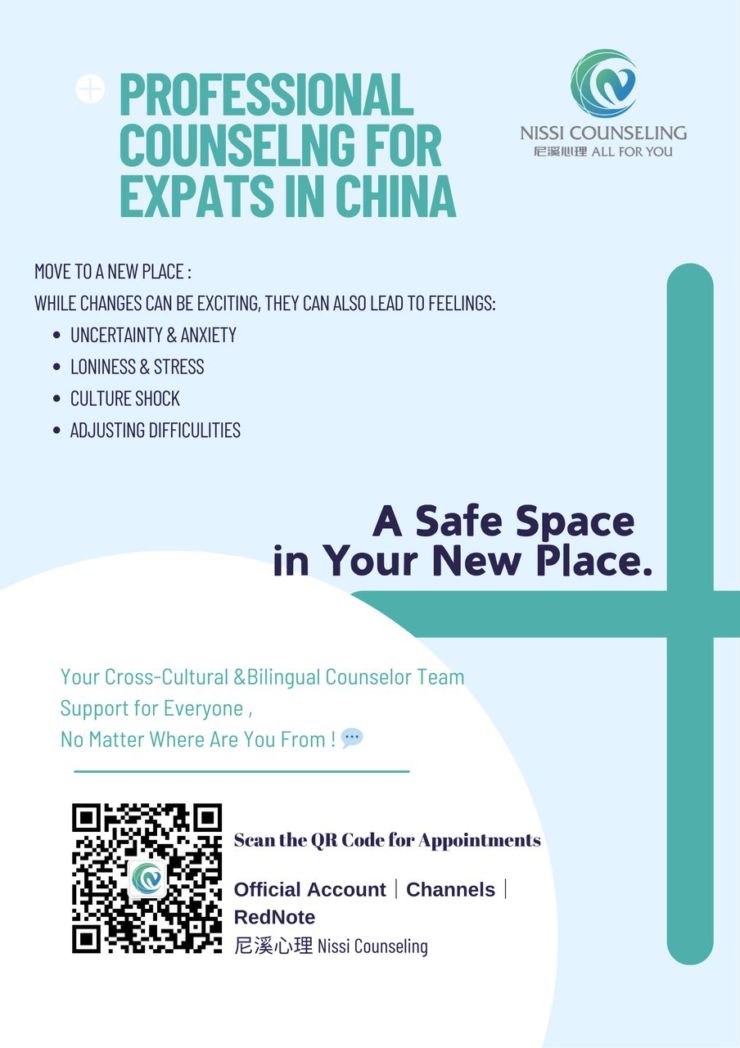
About Nissi Counseling Chengdu:
As one professional psychological counseling team based in Chengdu since 2018, Nissi Counseling comprises trained professional bilingual counseleors with professional competencies and cultural sensitivity for individuals, couples and families.
Besides providing counseling services, Nissi Counseling is also dedicated to general psychology education in China and promoting diversity, to truly achieve our mission “help people to help themselves”.
We can help with the following:
Counseling and Psychological Services:
· Depression, anxiety, phobia, OCD, stress, grief, and other moving and mental health issues.
· Career planning, relationship-building communication, family, and relationship problems.
· Social disorders, interpersonal communication, family and relationships problems
· Children and adolescent development (emotional and behavioral problems, rehabilitation training for children with autism, ADHD, etc.)
· Online counseling for returnees/ overseas students, Chinese with foreign passports overseas
Group Training Services:
Emotion management, stress management, communication management, positive thinking training.
Counseling & Psychological Help for Expats:
Talk with a professional counselor face-to-face.
Visit by appointment only.
Languages: English, Korean, Mandarin, Cantonese
Our assistant will send you an “invitation code” before your appointment, and you will be able to enter the building with the invitation code.

Information & Contact
Please feel free to add us on WeChat for professional counseling and psychological support
⇣

Address:
Zhonghai International Center Building B, No. 177, Jiaozi Avenue, Wuhou District
成都市武侯区交子大道117号中海国际B座5楼